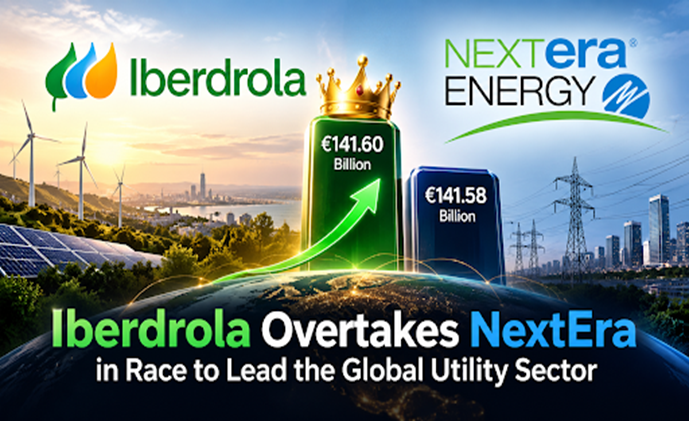
The global electricity industry is entering a period of significant transformation, driven by rising power consumption, renewable energy development, and the need to modernize ageing infrastructure. Against this backdrop, Iberdrola has reached a notable milestone by moving ahead of NextEra Energy in market capitalization, positioning the Spanish energy company as the world’s most valuable publicly listed utility.
On October 6, 2026, Iberdrola’s market capitalization reached €141.60 billion at midday, narrowly surpassing NextEra Energy’s €141.58 billion. Although the difference was minimal, the development highlighted changing investor expectations about the future of the utility sector and the strategies best suited to long-term growth.
The close competition also demonstrates that leadership in the electricity industry increasingly depends on more than renewable energy capacity alone. Geographic diversification, regulated infrastructure investments, financial performance, and exposure to growing electricity demand are becoming equally important considerations.
Two Energy Giants, Two Different Strategies
Despite competing for the same position, Iberdrola and NextEra Energy have developed distinct business models.
NextEra Energy maintains a strong presence in the United States through Florida Power & Light, its regulated electricity business, and NextEra Energy Resources, which focuses on renewable generation and related energy projects. Its concentrated domestic operations provide access to a substantial electricity market, but they also expose the company to US regulatory decisions, economic conditions, and political developments.
Iberdrola follows a more internationally diversified approach. Its operations span several markets, including Spain, the United Kingdom, the United States, Brazil, Mexico, and Australia. The group operates in Britain through ScottishPower, in the United States through Avangrid, and in Brazil through Neoenergia.
Avangrid has an established presence in regulated electricity markets, including New York, Maine, and Connecticut, while also developing renewable energy projects. This international footprint allows Iberdrola to distribute investment across different economic environments and regulatory systems.
Geographic diversification does not eliminate business risks, but it can reduce dependence on a single country’s policy decisions or market conditions. For investors evaluating utility companies, that balance may become increasingly valuable as energy markets experience structural changes.
A Century of Development Supports Iberdrola’s Position
Iberdrola’s recent achievement reflects a much longer history of development. Its origins date to Hidroeléctrica Ibérica, established in 1901, giving the company a 125-year history in 2026.
Over the decades, the business has evolved from its early electricity-generation roots into an international energy group with substantial interests in renewable power and electricity networks. Its strategy increasingly emphasizes infrastructure capable of supporting a more electrified economy.
Power grids are particularly important because renewable generation must be connected efficiently to consumers and businesses. Modern networks also need to accommodate changing consumption patterns, distributed energy resources, and growing demand from digital infrastructure.
By allocating substantial capital to these areas, Iberdrola is positioning itself to benefit from the continuing modernization of electricity systems across several major economies.
The companies’ contrasting share-price movements have contributed to the change in their relative valuations.
Iberdrola’s shares gained close to 15% between the beginning of 2026 and the reported October milestone, reaching record levels during the year. This performance indicates stronger investor confidence in the company’s growth prospects and investment strategy.
NextEra Energy, meanwhile, experienced a decline of approximately 20% following its announcement of a proposed $67 billion acquisition of Dominion Energy. According to the supplied report, the transaction has faced increasing political opposition in Virginia.
A major acquisition can expand a company’s operations and create opportunities for future growth. However, it can also introduce financing requirements, integration challenges, and regulatory uncertainty. For NextEra, the proposed transaction has raised questions about the risks associated with increasing its concentration in the US market.
The deal’s eventual outcome could influence the competitive balance between the two companies. Nevertheless, market capitalization changes continually, meaning Iberdrola’s lead should not automatically be interpreted as a permanent shift in industry rankings.
Analysts Identify Further Growth Potential
Recent analyst assessments have added to the positive outlook surrounding Iberdrola. On October 1, Goldman Sachs upgraded its recommendation on the company from neutral to buy and increased its price target from €21 to €25.
The bank’s outlook anticipates annual earnings growth of approximately 10% through 2031, supported by an investment programme of around €100 billion. Roughly 70% of the planned spending is expected to target regulated electricity networks, particularly in the United States and the United Kingdom.
Deutsche Bank also upgraded its recommendation to buy shortly before the Goldman Sachs announcement. Its assessment indicated that Iberdrola’s double-digit earnings growth, established in 2022, could continue through 2028.
These forecasts depend on successful project execution, regulatory conditions, financing costs, and broader market developments. Even so, they suggest that analysts see electricity infrastructure as a major source of potential earnings growth.
Rising Electricity Demand Creates New Opportunities
The competition between Iberdrola and NextEra comes as the energy industry prepares for a new investment cycle. Electrification across transportation, industry, and buildings is increasing the need for reliable electricity supplies. Meanwhile, the expansion of data centers is creating additional demand, particularly as digital services and artificial intelligence applications grow.
Existing electricity networks also require substantial upgrades to maintain reliability and accommodate new generation capacity. Goldman Sachs expects European electricity demand to increase by 1.5% to 2% annually over the next two to three years, potentially accelerating to approximately 3% per year afterward.
In the United States, utility-sector deal activity reached record levels during the first half of 2026, according to the supplied information. This reflects the strategic importance of securing infrastructure and meeting future energy requirements.
What Comes Next for the Global Utility Sector?
Iberdrola’s narrow advantage over NextEra Energy illustrates how investor priorities are evolving. Both companies operate in a sector with substantial long-term opportunities, but their differing geographic footprints and investment decisions may influence how markets value them.
NextEra’s proposed Dominion acquisition remains an important factor to watch, while Iberdrola’s planned infrastructure spending will require disciplined execution to deliver the expected returns.
Ultimately, the contest is about more than which company occupies the top position in market capitalization on a particular day. It highlights the growing importance of resilient business models, international exposure, and investment in electricity networks as global power demand expands.
As utilities prepare for decades of infrastructure development, the companies that combine financial discipline with reliable service and strategic investment may be best positioned to maintain investor confidence and strengthen their competitive standing.