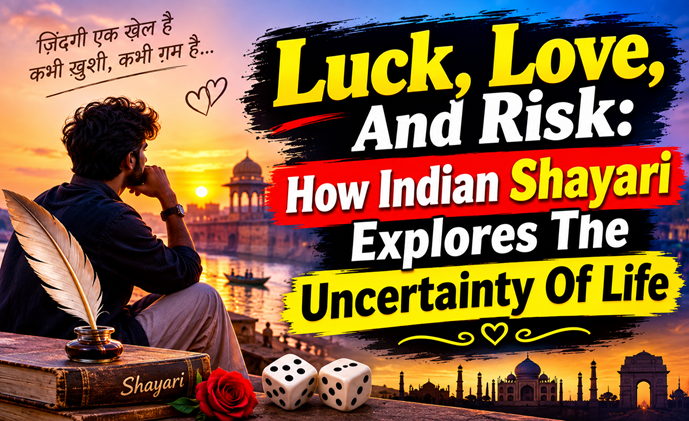
Life rarely follows a clear path. People fall in love, make plans, face loss, and hope for better days. Yet no one can know exactly what tomorrow will bring.
Indian Shayari gives these feelings a voice.
Rooted in Hindi and Urdu poetic traditions, Shayari uses rhythm, imagery, and emotion to express thoughts that ordinary speech may struggle to capture. Its verses often explore love, fate, hope, and heartbreak.
One common theme is the link between luck and human choice.
A poet may compare love to a game of chance. Trust becomes a risk, hope becomes a wager, and heartbreak feels like losing something precious.
These images draw on the language of gambling, but their meaning reaches far beyond money or games.
They reflect a simple truth: people make choices without knowing how those choices will end.
In Shayari, fate does not always reward courage, and love does not always follow reason. That tension gives poetry much of its emotional force.
By turning uncertainty into vivid words, Indian poets help readers explore the fears and hopes that shape everyday life.
How Luck And Chance Shape The Language Of Indian Shayari
Luck plays a key role in Hindi and Urdu poetry. Poets often use chance to explain why love succeeds, why dreams fail, and why good plans can lead to pain.
In Shayari, kismat, the Hindi and Urdu word for fate or destiny, often stands for forces people cannot control.
A person may give their whole heart to someone yet receive no love in return. Another may find joy through an unexpected meeting. These moments feel like the turn of a card or the roll of dice.
Gambling metaphors help poets express this lack of control. Winning can stand for finding love, while losing can reflect heartbreak or regret.
Such images also connect traditional poetry with modern digital culture. An entertainment service such as a desi play app may use chance and uncertain results to create suspense. Shayari draws on the same sense of anticipation but turns it into a story about human feelings.
The difference lies in what is at stake. In a game, the result follows set rules. In love, no rule can promise trust, loyalty, or happiness.
This contrast makes luck a powerful poetic theme.
Shayari reminds readers that effort and outcome are not always equal. People can choose their actions, but they cannot control every result.
Why Love And Risk Often Appear Together In Shayari
Love asks people to trust someone without knowing what will happen next. This makes it one of the most common forms of risk in Indian poetry.
In Hindi and Urdu Shayari, the heart often stands for something precious that a person chooses to place in another’s hands. That choice can bring joy, but it can also lead to pain.
Poets use images of wagers, bargains, and loss to describe this feeling. A lover may give everything without asking for a reward. Another may hold back out of fear.
These images make complex emotions easy to grasp.
Risk in love differs from risk in a game. A game has fixed rules and clear results. Human bonds depend on trust, time, and choices that can change.
Shayari captures this difference through simple scenes: an unanswered letter, an empty street, or a long wait for someone who may never arrive.
Such details turn uncertainty into something readers can picture.
The central idea is clear: love requires courage, but courage cannot guarantee love in return.
How Fate And Personal Choice Create Tension In Indian Poetry
Indian Shayari often asks a simple question: Do people shape their own lives, or does fate decide what happens?
Poets rarely offer one clear answer. Instead, they show people caught between what they want and what life allows.
A lover may travel far to meet someone, only to arrive too late. Another may wait for years, hoping that time will change someone’s heart.
These scenes place personal effort against uncertain results.
In Hindi and Urdu poetry, taqdeer often refers to destiny, while umeed means hope. Poets use these ideas to show how people keep trying even when success seems unlikely.
Fate can explain an unexpected loss, but it can also offer comfort when plans fail.
Yet Shayari does not always present people as helpless. Its speakers make choices, take risks, and accept the results.
The tension between fate and free will gives these poems their depth. Readers see that they cannot control every event, but their choices still matter.
Why Shayari Helps Us Understand Life’s Uncertainty
Indian Shayari turns life’s unknowns into words that feel close to home. Through images of luck, love, and risk, poets show how people face hope, loss, and change.
Luck may shape an outcome, but personal choices shape the journey. A person can offer love without knowing if it will return. They can work toward a dream without knowing if it will come true.
Shayari gives these moments meaning through simple, vivid images.
Its use of gambling metaphors does not make life a game. Instead, it shows how much people value what they cannot fully control.
The lasting strength of Shayari lies in its honesty about uncertainty. It offers no promise that every risk will pay off. It shows why people still choose to hope, trust, and try again.