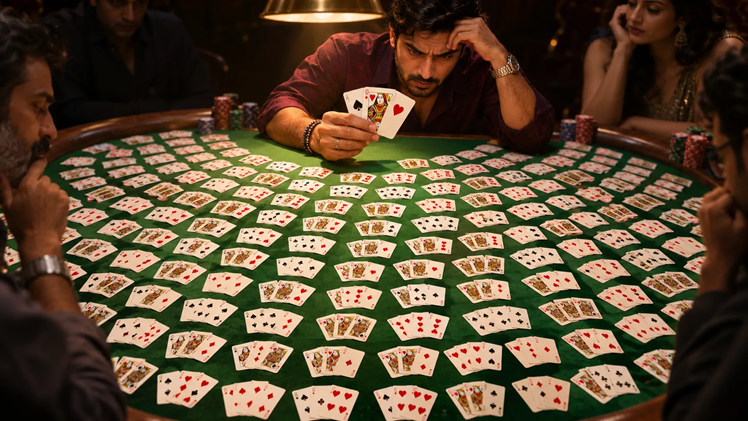
A Pair appears in 3,744 of the 22,100 possible three-card hands, which is 16.94%, or roughly once in every six deals. It is the most common hand that feels strong, and the one that produces the most expensive mistakes. At a three-handed table a Pair of Kings is beaten about 19% of the time; at a six-handed table that rises to 42%. Same cards, same pot size, very different decision.
This guide uses the standard teen patti probability figures to break the Pair down properly: how the 3,744 hands split across thirteen ranks, what the kicker does and does not do, and how to price a Pair at different table sizes.
Where the 3,744 Hands Come From
A Pair needs three cards in which two share a rank and the third differs. For each of the thirteen ranks there are six ways to pick the two suited cards, and forty-eight remaining cards that can be the kicker. Thirteen × six × forty-eight equals 3,744. Every rank therefore has exactly 288 combinations, which means a Pair of Aces and a Pair of Twos are equally likely to be dealt.
That symmetry is the first useful fact. Rarity does not increase with rank; only strength does. A player who waits for a Pair of Aces is waiting just as long as a player waiting for a Pair of Twos, and receiving a much better hand when it arrives.
| Category | Combinations | Share of deals |
| Pair, any rank | 3,744 | 16.94% |
| Pair of Aces | 288 | 1.30% |
| Pair of Kings | 288 | 1.30% |
| Pair of any one rank | 288 | 1.30% |
What Beats Each Pair
Ranking in Teen Patti runs Trail, Pure Sequence, Sequence, Colour, Pair, High Card. A Pair therefore loses to every Colour, every Sequence, every Pure Sequence and every Trail, and to any higher Pair. Only 8.67% of hands fall into the first four categories, so a pair of Aces is beaten by 8.67% of single hands. A lower pair adds the higher pairs to that list.
| You hold | Beaten by one opponent | Beaten by five opponents |
| Pair of Aces | 8.7% | 36.5% |
| Pair of Kings, J kicker | 10.2% | 41.6% |
| Pair of Queens, J kicker | 11.4% | 45.4% |
| Pair of Nines, J kicker | 15.3% | 56.4% |
| Pair of Fives, J kicker | 20.5% | 68.3% |
| Pair of Twos, J kicker | 24.4% | 75.3% |
The pattern is worth memorising in shape rather than in detail. A high pair is beaten by roughly ten per cent of single hands; a low pair by roughly a quarter. Multiply that by the number of active opponents and the same hand moves from favourite to underdog somewhere around the fourth seat.
The Kicker: Small Effect, Big Arguments
The third card in a pair hand only matters when both players hold the same pair rank. Two players with a Pair of Kings compare kickers; the higher kicker wins. Since each rank has exactly 288 combinations spread across twelve kicker ranks, a kicker of Jack beats roughly seven of the eleven possible alternatives below it.
Against every other hand in the game, the kicker is irrelevant. A Pair of Kings with a Two kicker beats a Pair of Queens with an Ace kicker, and a Pair of Kings with an Ace kicker still loses to any Colour. Players who fold a pair because the kicker is small are usually folding a hand that was beaten or beating for reasons the kicker never touched.
Where the kicker genuinely matters is the tail end of a hand: two players both holding a middle pair and one of them holding the higher third card. That situation is uncommon, but it is the only one in which the third card decides money.
Pair Sizing by Table
The single most consequential number for a pair is the count of live opponents, not the pair’s rank.
Three-handed with a Pair of Kings: two opponents beat you 19.3% of the time, so you are ahead four times in five. Calling moderate raises is fine and raising yourself is defensible. Six-handed with the same hand: five opponents beat you 41.6% of the time, so you are ahead less than three times in five, and a large call is a coin flip with a worse price. Pair of Fives three-handed: 37.5% beaten, still playable small. Pair of Fives six-handed: 69.1% beaten, which makes any substantial call a losing proposition.
Three Habits That Fix Pair Play
First, decide the hand’s value before the pot grows. A pair that is marginal at the first call does not become strong because the pot is now large; the pot size changes the price, not the hand. Second, count active players every round, because the number that decides whether a pair is good is the number still betting against you. Third, separate “I have a pair” from “I have the best hand”, which are different statements, and only the second one justifies a large call.
Players learning how to play teen patti usually overvalue the pair for a simple reason: it is the first hand that looks like a real hand. The correction is arithmetic rather than attitude. Against one opponent a pair is strong; against five it is a lottery ticket with a decent number.
Risk and Accuracy Notes
The counts above are exact for a single standard 52-card deck with conventional ranking, no joker, and the usual order in which Colour outranks Sequence. Rooms that add a joker or invert the ranking for Muflis change both the pool and the comparisons, so these figures do not transfer. Where two hands are identical, settlement depends on the room’s tie rule and should be checked rather than assumed. Chips in practice and social rooms are usually virtual and cannot be withdrawn; where real-money play exists, local law and platform terms decide who may take part. A pair is a statistical holding, not a promise.
The Takeaway
Memorise three numbers: 16.94% of deals, 288 combinations per pair rank, and a per-opponent risk that runs from about 9% for Aces to about 24% for Twos. Then apply the opponent count before you apply the chips. A Pair is a good hand at a short table and an ordinary one at a full table, and knowing which you are in is most of the skill.